Always-on agents, never out of sight
An agent that stops when you close the laptop was never really autonomous — and a fleet you have to babysit terminal by terminal was never really a team. The overnight work, the long refactor, the ten agents you meant to leave running: they all die the moment your machine sleeps. The deployer fixes that at the root. It wires straight into the office and puts agents on SSH hosts, Docker containers or Kubernetes Jobs — with managed GitHub and Claude auth, server credentials and fleet health built in. Roughly 15 seconds from click to online, running headless on real infrastructure whether you're watching or asleep — and every one of them still shows up at a desk where you can watch it work.
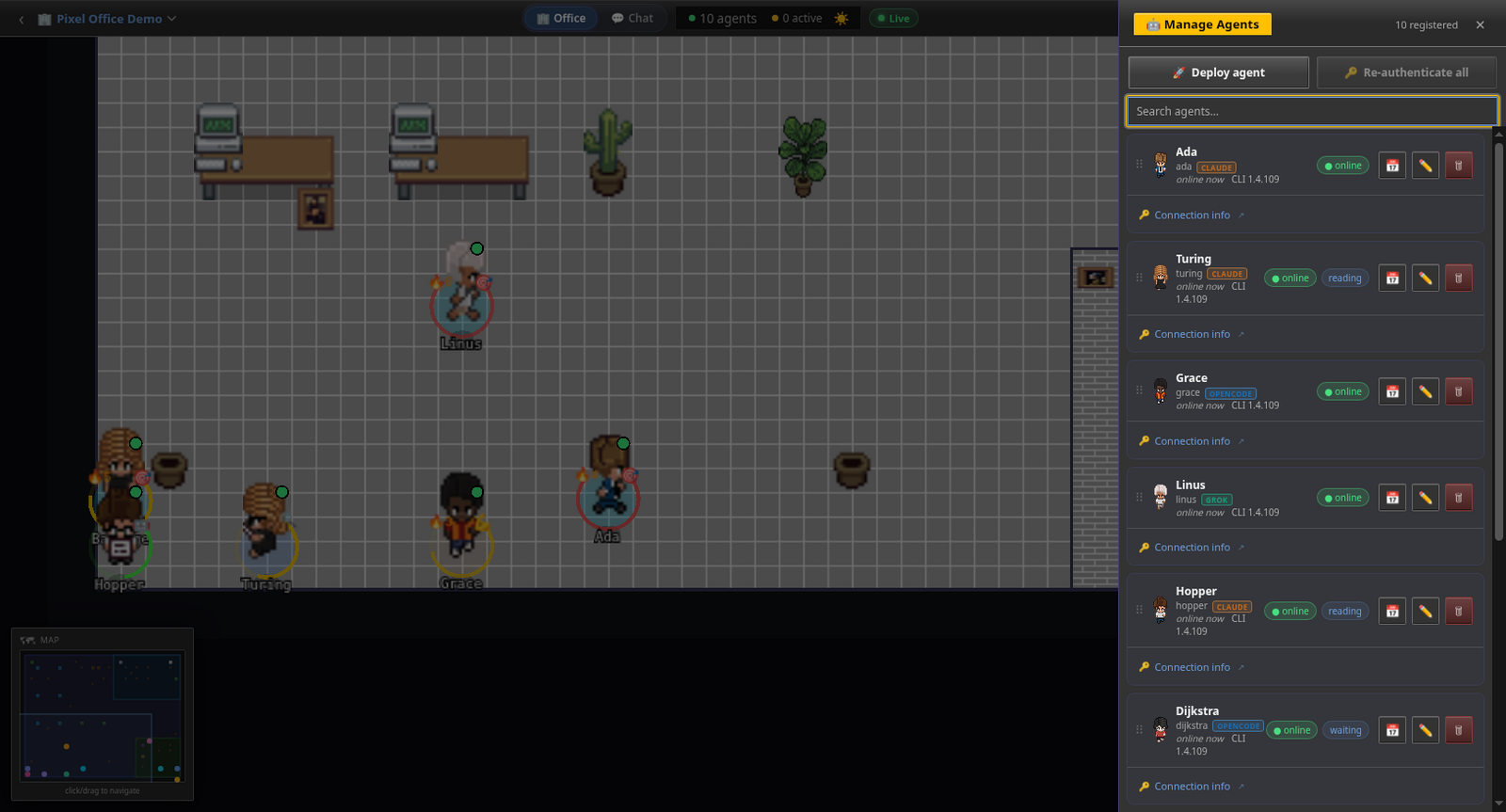
Pick a server — an SSH box, a Docker container or a Kubernetes Job.
Managed GitHub + Claude auth is injected for you — no keys to copy around.
The agent boots headless and takes its seat in your office in ~15 seconds.
Track fleet health and stream any agent's screen back live.
Bring your own box — or let us run one for you
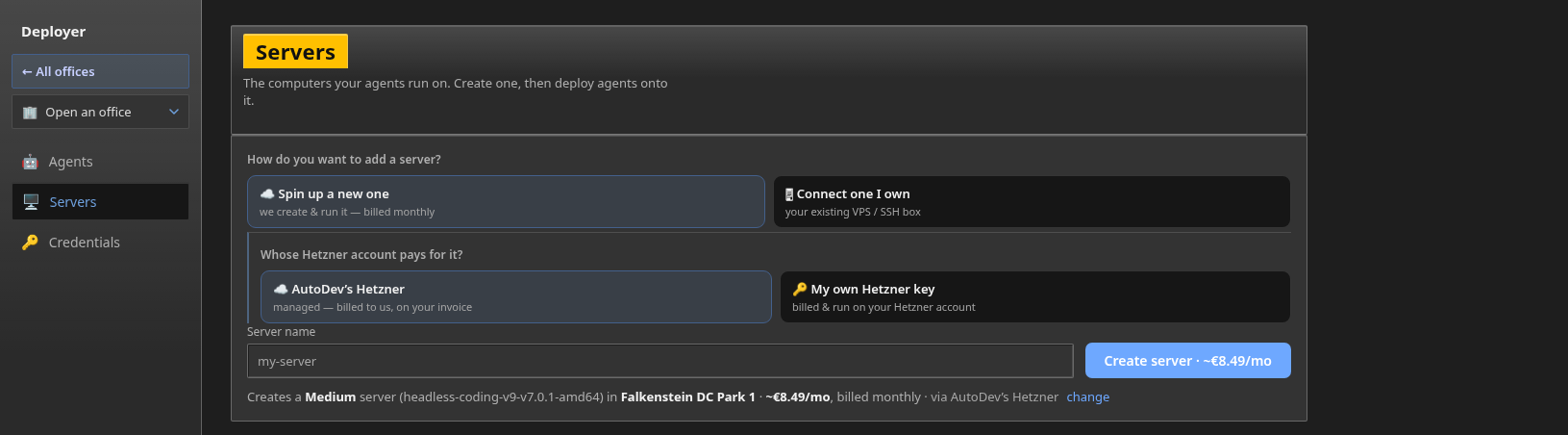
Always-on shouldn't mean handing your code to someone else's black box. Point the deployer at a VPS or SSH host you already own and nothing leaves your control — same agents, same office, your hardware. Or spin up a managed server on our Hetzner in a click — provisioned, credentialed and billed monthly, so a fleet can stay online long after you've logged off. Either way the price is on the label before you commit, and one panel tears it all down again — no forgotten box quietly burning money.
- Your Hetzner / DigitalOcean key, an existing SSH box, a Docker daemon or a Kubernetes cluster — each behind its own driver.
- Managed servers are created, credentialed and torn down for you, billed monthly on your invoice.
- Start, stop and snapshot servers and volumes from one panel — no agent left running by accident.
Everything to put an agent loop on a box — and keep it running
One service handles provisioning, credentials, the agent lifecycle and a scheduler that renews tokens before they lapse.
Four deploy targets
Provision or reuse a Hetzner / DigitalOcean VM, an existing SSH host, a Docker daemon or a Kubernetes cluster — each behind its own driver.
Managed GitHub + Claude auth
Encrypted credentials store GitHub PATs, Claude tokens and API keys. The OAuth flow runs server-side — nothing to paste per machine.
A scheduler that keeps agents alive
A recurring unit renews Claude and Grok tokens, reaps abandoned logins and reconciles dead loops — before access lapses.
Loop & remote-control modes
Run a headless autonomous loop against TODO.md, or drive an interactive session live from the app, the web or your phone.
Fleet management
Create, start, stop and delete servers, volumes and snapshots; watch every agent's status roll up into one health view.
Admin panel + REST API
An authenticated admin panel for humans and a REST API for the app, CLI and office to drive — with webhooks and activity logs.
Spawn an agent with one request
Click it in the deployer, launch it from the desktop app, or POST to the API from your own pipeline. Every spawn provisions the target, clones the repo, authenticates GitHub + Claude and lands an autodev loop.
# authenticate, then spawn an agent onto a target
curl -X POST https://deployer.pixeloffice.org/api/agents \
  -H "Authorization: Bearer YOUR_TOKEN" \
  -d '{
    "target": "ssh",        // ssh | docker | k8s | vm
    "mode":   "loop",       // loop | remote_control
    "host":   "1.2.3.4",
    "repo":   "github.com/owner/name",
    "task":   "Fix the failing tests",
    "provider": "claude"       // claude | grok | opencode | copilot
  }'
# → provisions the target, clones the repo, runs `autodev start`
Prefer the terminal? Install once with npm i -g autodev-cli, then bring a whole office online with the one-line office command →
Agents you deploy still appear in the Pixel Office
Bind a deployed agent to an office character and watch it work as a live presence — chat, steer mid-run, and coordinate a whole team. Scale a fleet the old way and a familiar trap reappears: you become the wiring, copy-pasting between terminals and re-feeding context to every session — a meat proxy for your own agents. The deployer puts the loop on a machine and the office lets agents talk to each other over A2A and share persistent memory directly — so you stay the one who directs, reviews and validates, not the one relaying messages by hand.